> For the complete documentation index, see [llms.txt](https://darren.gitbook.io/project/llms.txt). Markdown versions of documentation pages are available by appending `.md` to page URLs; this page is available as [Markdown](https://darren.gitbook.io/project/k8s-yun-wei-pai-cha/gu-zhang-chu-li/quan-xian-guan-li-rbac.md).
# 权限管理RBAC
Kubernetes集群的所有操作基本上都是通过kube-apiserver这个组件进行的,它提供HTTP [RESTful](https://www.centos.bz/tag/restful/)形式的API供集群内外客户端调用。需要注意的是:认证授权过程只存在[HTTPS](https://www.centos.bz/tag/https/)形式的API中。也就是说,如果客户端使用HTTP连接到kube-apiserver,那么是不会进行认证授权的。所以说,可以这么设置,在集群内部组件间通信使用HTTP,集群外部就使用HTTPS,这样既增加了安全性,也不至于太复杂。


基本结构主要就是三个:
* 权限: 即对系统中指定资源的增删改查权限
* 角色: 将一定的权限组合在一起产生权限组,如管理员角色
* 用户: 具体的使用者,具有唯一身份标识(ID),其后与角色绑定便拥有角色的对应权限
**Kubernetes 是不负责维护存储用户数据的;对于 Kubernetes 来说,它识别或者说认识一个用户主要就几种方式**
* X509 Client Certs: 使用由 k8s 根 CA 签发的证书,提取 O 字段
* Static Token File: 预先在 API Server 放置 Token 文件(bootstrap 阶段使用过)
* Bootstrap Tokens: 一种在集群内创建的 Bootstrap 专用 Token(新的 Bootstarp 推荐)
* Static Password File: 跟静态 Token 类似
* Service Account Tokens: 使用 Service Account 的 Token
其他不再一一列举,具体请看文档 [Authenticating](https://kubernetes.io/docs/admin/authentication/);了解了这些,后面我们使用 RBAC 控制 kubectl 权限的时候就要使用如上几种方法创建对应用户
RBAC 权限定义部分主要有三个层级
* apiGroups: 指定那个 API 组下的权限
* resources: 该组下具体资源,如 pod 等
* verbs: 指对该资源具体执行哪些动作
定义一组权限(角色)时要根据其所需的真正需求做最细粒度的划分
下图是 API 访问要经过的三个步骤,前面两个是认证和授权,第三个是 Admission Control
client发起apiserver调用时,apiserver先**认证(Authentication)用户,再给用户**授权(Authorization),最后执行**准入控制(Admission Control)**
* 认证:鉴别发起请求的**用户**是否合法
* 授权:授予用户**api请求**权限,并鉴别用户访问的**api请求**是否合法
* 准入控制:一些额外的检查机制,用于做最后的拦截

#### TLS原理
基于CA根证书签名的双向数字证书认证
* client和server向CA机构申请证书
* client->server,server下发服务端证书,client利用证书验证server是否合法
* client发送客户端证书给server,server利用证书校验client是否合法
* client和server利用随机密钥加密消息,然后通信
{% embed url="" %}
## 授权
授权就是授予用户请求权限,并鉴别用户的api请求是否合法的过程
目前支持的几种授权策略:
* AlwaysDeny:拒绝所有请求,用于测试
* AlwaysAllow:允许所有请求,k8s默认策略
* ABAC:基于属性的访问控制。表示使用用户配置的规则对用户请求进行控制
* RBAC:基于角色的访问控制
* Webhook:通过调用外部rest服务对用户授权
RBAC的四个资源对象:
1. Role:一个角色就是一组权限的集合,拥有某个namespace下的权限
2. ClusterRole:集群角色,拥有整个cluster下的权限
3. RoleBinding:将Role绑定目标(user、group、service account)
4. ClusterRoleBinding:将ClusterRoleBinding绑定目标
一个典型的映射关系
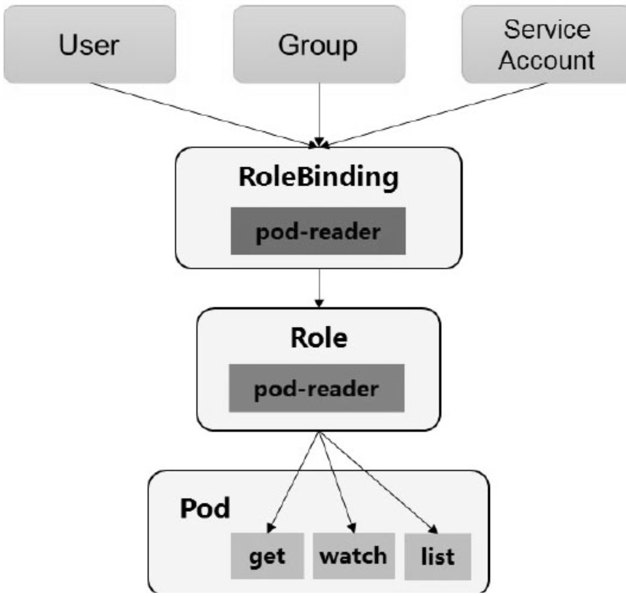
##
为kubernetes 访问用户添加权限控制
了方便增加了一个`admin`用户,然后授予了`cluster-admin`的角色绑定,而该角色绑定是系统内置的一个超级管理员权限,也就是用该用户的`token`登录`Dashboard`后会很**强势**,什么权限都有,想干嘛干嘛,这样的操作显然是非常危险的。接下来我们来为一个新的用户添加访问权限控制。
### Role
`Role`表示是一组规则权限,只能累加,`Role`可以定义在一个`namespace`中,只能用于授予对单个命名空间中的资源访问的权限。比如我们新建一个对默认命名空间中`Pods`具有访问权限的角色:
```
kind: Role
apiVersion: rbac.authorization.k8s.io/v1beta1
metadata:
namespace: default
name: pod-reader
rules:
- apiGroups: [""] # "" indicates the core API group
resources: ["pods"]
verbs: ["get", "watch", "list"]
```
### ClusterRole
`ClusterRole`具有与`Role`相同的权限角色控制能力,不同的是`ClusterRole`是集群级别的,可以用于:
* 集群级别的资源控制(例如 node 访问权限)
* 非资源型 endpoints(例如 /healthz 访问)
* 所有命名空间资源控制(例如 pods)
比如我们要创建一个授权某个特定命名空间或全部命名空间(取决于绑定方式)访问**secrets**的集群角色:
```
kind: ClusterRole
apiVersion: rbac.authorization.k8s.io/v1beta1
metadata:
# "namespace" omitted since ClusterRoles are not namespaced
name: secret-reader
rules:
- apiGroups: [""]
resources: ["secrets"]
verbs: ["get", "watch", "list"]
```
### RoleBinding和ClusterRoleBinding
`RoloBinding`可以将角色中定义的权限授予用户或用户组,`RoleBinding`包含一组权限列表(`subjects`),权限列表中包含有不同形式的待授予权限资源类型(users、groups、service accounts),`RoleBinding`适用于某个命名空间内授权,而 `ClusterRoleBinding`适用于集群范围内的授权。
比如我们将默认命名空间的`pod-reader`角色授予用户jane,这样以后该用户在默认命名空间中将具有`pod-reader`的权限:
```
# This role binding allows "jane" to read pods in the "default" namespace.
kind: RoleBinding
apiVersion: rbac.authorization.k8s.io/v1beta1
metadata:
name: read-pods
namespace: default
subjects:
- kind: User
name: jane
apiGroup: rbac.authorization.k8s.io
roleRef:
kind: Role
name: pod-reader
apiGroup: rbac.authorization.k8s.io
```
`RoleBinding`同样可以引用`ClusterRole`来对当前 namespace 内用户、用户组或 ServiceAccount 进行授权,这种操作允许集群管理员在整个集群内定义一些通用的 ClusterRole,然后在不同的 namespace 中使用 RoleBinding 来引用
例如,以下 RoleBinding 引用了一个 ClusterRole,这个 ClusterRole 具有整个集群内对 secrets 的访问权限;但是其授权用户 dave 只能访问 development 空间中的 secrets(因为 RoleBinding 定义在 development 命名空间)
```
# This role binding allows "dave" to read secrets in the "development" namespace.
kind: RoleBinding
apiVersion: rbac.authorization.k8s.io/v1beta1
metadata:
name: read-secrets
namespace: development # This only grants permissions within the "development" namespace.
subjects:
- kind: User
name: dave
apiGroup: rbac.authorization.k8s.io
roleRef:
kind: ClusterRole
name: secret-reader
apiGroup: rbac.authorization.k8s.io
```
最后,使用 ClusterRoleBinding 可以对整个集群中的所有命名空间资源权限进行授权;以下 ClusterRoleBinding 样例展示了授权 manager 组内所有用户在全部命名空间中对 secrets 进行访问
```
# This cluster role binding allows anyone in the "manager" group to read secrets in any namespace.
kind: ClusterRoleBinding
apiVersion: rbac.authorization.k8s.io/v1beta1
metadata:
name: read-secrets-global
subjects:
- kind: Group
name: manager
apiGroup: rbac.authorization.k8s.io
roleRef:
kind: ClusterRole
name: secret-reader
apiGroup: rbac.authorization.k8s.io
```
案例实践;